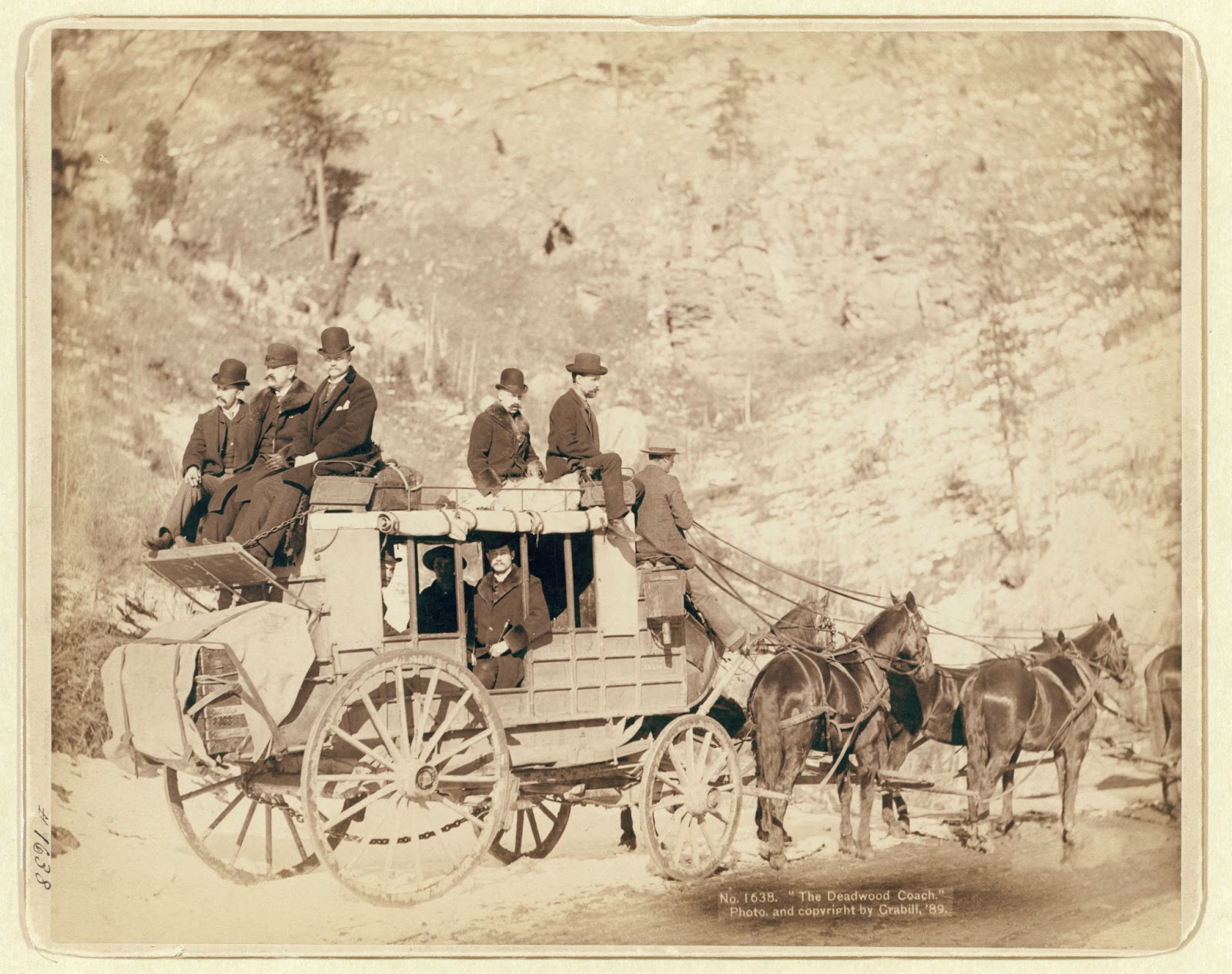
The Deadwood Coach. Photo taken in 1889 by John C. Grabill.
Stagecoach travel was a dangerous business in the American West. Roads were rocky, rutted, and sometimes impassible. Bandits, a constant threat, viewed stagecoach passengers like cats watching birds in a cage. It was also an uncomfortable form of travel. On long trips, passengers generally slept sitting up, or not at all, as it was considered bad etiquette to rest ones head on another passenger. Rest stations, or swing stations, were used to change out horses and rarely offered food. Nevertheless, the stagecoach was a popular form of travel in the American West, particularly during a time when the only other option was a wagon or the back of a horse! Stagecoach Design: The Concord Stagecoach The Concord Stagecoach was used most often by stagecoach companies. It was built like a basket on leather straps that swung from side to side. Concords had seats in front, in back, and in the middle, seating nine when full and leaving little leg room with seating for up to 12 passengers on top. The creators of the Concord were J. S. Abbot and Lewis Downing, meticulous craftsmen who personally inspected every coach that left the factory. The Abbot Downing Company had a huge factory in Concord, New Hampshire on six acres. They offered designs for forty coaches and wagons. The company was supervised by one of the Abbot or Downing family members from 1827 to 1899. 
Concord Stagecoach. Photo taken in 1869.
According to The Story of the Great American West, Concord coaches came in various heavily varnished, bright colors and various sizes, as well. They were 8 1/2 feet long (now imagine the space inside of the coach), weighed 2500 pounds, which could be deadly if they tipped over on a road, and cost around $1300 depending on the amount of detail. The Jehu, or Stagecoach Driver Jehu is a Biblical name given to stagecoach drivers. Jehu was a king of Israel in the ninth century who, according to II Kings, ordered the death of Jezebel according to Elijah's prophecy. On the Old West Stagecoach, the jehu was the man, he was in charge. He was the one who shouted, "All aboard! Away!" as the passengers scrambled to find their seats and they did scramble, because it was often vitally important for the jehu to keep his schedule and he was not willing to wait for slackers fumbling around inside the coach. Stagecoach's were not just for passengers. They often carried important legal documents, large bank deposits, or company payrolls. The Jehu held three pairs of reins in his left hand, which kept his right hand free to hold the whip. According to The Story of the Great American West, The jehu also spoke to the horses, not just shouting commands, but also encouragement, and sometimes soothing words when the stagecoach was in a precarious situation, such as traveling a mountain road. The jehu's hold on the reins was careful, sensitive, like a pianist touching the keys of a piano because he knew the horses responded to the slightest movement of those reins and depended on him for guidance at every moment. The jehu often wore thin gloves so he could more carefully guide the reins. Unfortunately, this sometimes led to frostbite--it was not an easy job! Stagecoach Companies: Ben Holladay and the Overland Express According to David Niven's The Expressmen, one of the most famous stagecoach owners and operators was Ben Holladay. Holladay's personal stagecoach had the appearance of a royal carriage with its gold scrollwork and prancing, dapple-gray horses, but Holladay could afford the extravagance. He owned the Overland Mail Express Company, which he bought from the Pony Express in 1862. He had a contract with the United States Post Office that paid $365,000 a year. The Overland transported humans, packages and mail over a 3000 mile area. Its stagecoach drivers wore velvet-trimmed uniforms and Irish wool overcoats, and Holladay paid them well. Holladay employed more than 15,000 people in the Overland Company with 110 Concord Stagecoaches. Holladay sold his stagecoach company to Wells Fargo in 1866 to invest in the railroads. The Dangers of Stagecoach Travel According to Wells Fargo History, during the gold rush years in the Rocky Mountains the Wells Fargo line had such a difficult time protecting its passengers and cargo that it created a standard form letter for reporting robberies. Wells Fargo nailed safes to the floorboards of the coaches, hired armed guards to protect shipments and taught silver shippers how to melt their precious metals into bars too large to be carried by men on the run, and still their stagecoaches were robbed. Wells Fargo finally created its own detective agency, but the salaries of these officers were so high they matched the amount previously lost in robberies. Nevertheless, the company felt some satisfaction in knowing justice was served when famous robbers such as John Sontag and Black Bart were apprehended or killed. The End of the Reign of the Stagecoach Ben Holladay made a wise financial decision when he sold the Overland Mail Express Company as railroads soon became the primary method of transporting both humans and cargo, but trains were still confined to their tracks. It was the introduction of the automobile that finally brought an end to the use of stagecoaches in the early 1900s. Sources:
|
Sunday, June 23, 2013
The Stagecoach: Fast, Efficient, Dangerous, and Miserable Form of Travel


Monday, May 20, 2013
Levi Strauss and the Jeans that Won the West

Levi Strauss was a German-Jewish immigrant from Bavaria who arrived in New York in search of the American Dream--and he found it! On Monday May 20th, 1874, Levi Strauss & Company first offered blue jeans with copper rivets at $13.50 a dozen, and the rest of the story, as they say, is history.
On May 20th, 1874, Levi Strauss introduced blue jeans with copper rivets bringing great joy to miners and workers across America who spent far too many years using rope to tie up their threadbare working pants!

Levi Strauss & Co. 506 jeans. Image by M62.

When Americans think of blue jeans, they think of Levis. Levi Strauss & Company has provided durable, attractive clothing for America’s cowboys, factory workers, and rebellious teens since the mid-1800s, and the story of Levi Strauss, the man, is as remarkable as the enduring success of the jeans that wear his name. |
How the Strauss Family Came to America
On February 26, 1829, Löeb "Levi" Strauss was born in Buttenheim, in the Franconian region of Bavaria, Germany, to Hirsch and Rebecca (Haass) Strauss, who already had three sons and three daughters. Löeb was nicknamed “Levi” by his family. Levi Strauss’s father died in 1845.

Levi Strauss portrait.
Prior to their father’s death, Strauss’s brothers left their homeland for the United States and started a dry goods business in New York City. In 1847, Strauss, his mother, and three sisters traveled to America to join his brothers. In 1853, Strauss earned his American citizenship. That same year, he also decided to follow the gold hunters headed for California, but Strauss was not seeking gold. His plan was to start a subsidiary of his brothers’ dry goods store, importing clothing, umbrellas, and other items to sell to small stores that were opening throughout California near mining towns.
Following the Crowds to California
Levi Strauss was a successful businessman in California and he decided to share his success with his family. He sent for his sister, Fanny, and hired his brother-in-law, David Stern, into the company. The business thrived, and by the time Strauss was in his mid-thirties, he was a popular business man in San Francisco.

Coal miners, Ouray County, Colorado, 1890

Jacob Davis Joins Levi Strauss
One day, Strauss received a letter from a customer, Jacob W. Davis, an immigrant from Latvia who arrived in the United States in 1868. Davis was a tailor in Reno, Nevada who had a design for a good pair of pants. He was purchasing fabric from Strauss to make tents and wagon covers. He started using copper rivets to reinforce horse harnesses. Then he came up with the idea of using these same copper rivets to hold pants together in areas under the most stress, and to use tent fabric to make the pants.

Levi's now come in many shapes and sizes for every member of the family.
Photo by Darla Sue Dollman.
Davis, however, lacked the necessary money to purchase a patent for his product. Levi Strauss met with Davis and the men agreed to become partners, creating the first official pair of Levi work pants in 1873. Within a matter of a few years, Levi Strauss & Company was making history with their durable pants for miners, factory workers and cowboys. These early pants, however, were died brown, and not the popular blue worn around the world today, and they were not widely distributed until the 1890s.
Disaster Strikes Levi Strauss & Company
In 1906, an earthquake struck San Francisco, California and the original factory on Battery Street and all historical records of the company were destroyed in the horrific fire storm that followed.

San Francisco, following the earthquake of 1906.

Following in the tradition of their benevolent uncle, Strauss’s nephews rebuilt the company as quickly as possible and during the process they continued to pay their employee’s salaries and to assist other business owners in their efforts to rebuild. Levi Strauss & Company is one of the most successful businesses in America to this day.
Beloved Citizen and Benefactor
Levi Strauss was a compassionate and generous man and regular contributor to the Pacific Hebrew Orphan Asylum and Home, the Eureka Benevolent Society, and the Hebrew Board of Relief. He also funded scholarships for poor students at the University of California. He never married.

Levi Strauss Museum in Buttenheim, Germany.

Levi Strauss died on September 26, 1902. He left the bulk of his fortune, nearly six million dollars, to his extended family, his favorite charities, and to the Roman Catholic Protestant Orphan Asylums. He left his factory and Levi Strauss & Company to his nephews, the children of Fanny and David Stern.
Levi Strauss is buried in Colma, California. In his obituary, the L.A. Times referred to Levi Strauss as “one of the last of the oldtime merchants of San Francisco and one of the best-known men from the most southerly limit of California to Puget Sound.”
There is now a Levi Strauss Museum in Buttenheim, Germany.
Sources:
- Downey, Lynn. "Levi Strauss & Company.” Levi Strauss & Co. Official Website. Retrieved January 10, 2010.
- Freeedman, Russell. Cowboys of the Wild West. Scholastic Inc.. Boston: 1985.
- “Levi Strauss Dead at San Francisco.” Published L.A. Times, September 28, 1902. Retrieved January 12, 2010.
- Levi Strauss California Museum. Retrieved April 20, 2013.
- “Our Past is a Glimpse into the Future.” Heritage. Levi Strauss & Company. Retrieved January 12, 2010.
Friday, May 10, 2013
Wallace Stegner, 'Living Dry'

Cholla at Sunset. Photo by Darla Sue Dollman
Thursday, May 2, 2013
Question about "Message Trees"

I have a question from a reader and I thought of posting the question on the article where it was attached, but it's a bit down on the list, so I think I'll open this topic up to everyone in case someone else has better information sources to help out. If you have an answer, you can comment on this post and I will notify her via email, or she'll see it on the blog. Either way, please help if you can! I think it would be great information to share with everyone! The question is below:
"I'm doing an article about the Message Trees. There is a trail between Colorado and New Mexico, where the cattlemen drove their cattle. They left messages in the trees along the way. The dates go back to early 1900. Do you know anything about this?" --Betty J. Slade
Tuesday, April 30, 2013
Ring-Tailed Cats, or Miner's Cats: Pest Control for Miners and Pioneers

Ring-tailed Cat, or Bassariscus astutus.

If you've ever wondered if pioneers, miners and settlers had pets the answer is yes. They had dogs, and perhaps even house cats, but in the Southwest, they had a special kind of pet, a pet that resembles a combination of cat and raccoon, and I've had the privilege of sharing my backyard and roof with one of these wonderful creatures, so I will begin with my story.

Cunning Bassarisc. Bassariscus astutus. Frank E. Beddard - The Cambridge Natural History, Volume X—Mammalia. Wikimedia Commons/Public Domain.

My husband and I were living in Texas a little over a year when we first realized we had a rather unique friend visiting our house at night. We lived in a round house with mostly glass walls for windows and glass doors--I often felt like a goldfish and the wildlife watched me as I moved through my home. I loved to climb onto the roof and photograph the sunset, but I always felt as if I was watched.
Our son told us he often heard noises in the garage at dusk and swore he saw what looked like a raccoon tail hanging down in front of the small garage window. Our house was on a mountainside and the garage backed to a slope, so it seemed logical that a raccoon might be climbing onto our roof, but why? They had free access to the squirrel and bird food on our bedroom patio, so they would not be seeking food. The raccoon theory didn't seem to fit. Still, it was a clue--a feeling of being watched and a raccoon tail.

Ring-Tailed Cat sprawling on a rock in Arizona. This is how the Ring-Tailed Cat
looked at us from the tree branch in our backyard. Photo by RobertBody.

The clues all came together one night around sunset when my husband realized he left the water hose running in the back yard. Suddenly I heard him calling my name. I ran to the garage and out into the yard and found him standing by the fence beneath a tree. Directly above his head was one of the strangest creatures I've ever seen--a Ring-Tailed Cat.
Ring-Tailed Cats are curious little creatures. Their heads resemble chihuahuas with pointy
ears and large eyes. They have the body of a limber, athletic house cat and a
long, striped tail like a raccoon. This little creature was sprawled out on a tree branch watching my husband as if he lived in the house and my husband was a visitor. It was a fascinating moment. He seemed perfectly comfortable with us and I suddenly realized why I often felt I was watched while on the roof in the evenings--because I was being watched!
A few nights later we were watching television in bed when we heard noises on the bedroom patio. This was not an isolated event. We were often visited by families of raccoons and an o'possum. On this night, though, it was the return of the ring-tailed cat. He raided the sunflower seeds in the squirrel dish then walked over to the door and stared inside at us for awhile before moving on.

The seven-foot Eastern Diamondback Rattlesnake that often visited our backyard, only at sunset, though, which gave us time to secure all of our pets and people inside the house.
Photo by Darla Sue Dollman.
In the five years we lived in the house the Ring-Tailed Cat often came by for a visit. Sadly, I never managed to photograph him. Nevertheless, we thought of him as a family friend, like the female toad, Mrs. Toady, who slept in my garden shoe during the hot summer afternoons, and the seven foot rattlesnake who slithered through our backyard at night to drink water from our pond.
Ring-Tailed Cats as Beneficial Pets
Of course, I studied the little creature so I could write articles about him on my animal blog, Blessed Little Creatures, and that's when I learned that although the Ring-Tailed Cat is often described as a solitary, nocturnal, and rather timid creature, it also has a reputation as a beneficial pet. In fact, Ring-Tailed Cats played an important role in the taming of the American West by helping to eliminate disease-spreading rodents like rats and mice.
They were favorites of miners and pioneers who cut holes in boxes and placed the boxes near the stove in the cabin or home to keep the animal warm during the day. At night, the ring-tailed cats would sneak out of their boxes to feed on the mice and rats that dared to enter the homes. This is how the ring-tailed cat earned its second name as the "Miner's Cat."
A Southwestern Native
The Ring-Tailed Cat is most often seen in the Southwest, in states such as Texas,
New Mexico, and north and central Mexico. They are also seen in California,
Colorado, Oklahoma, Oregon, Arizona, Nevada and Utah. Their location is
understandable considering they prefer to make their homes in rocky, desert
places, but they can also be found in the hollows of dead trees or in abandoned
buildings.

Ring-tailed Cat at Phantom Ranch, Grand Canyon National Park, Arizona.
Photographed by Pixelfugue.

To protect themselves from predators, they frequently move their
dens, rarely spending more than one night in the same place. They are amazingly
agile and flexible, and can rotate 180 degrees. They have also been seen
performing cartwheels and using their agile bodies to ricochet between walls!
A Rather Unique-Looking Cat!
The ring-tailed cat (Bassariscus astutus) can be tan or dark brown with a lighter underbelly. It has pointed ears and large, purple eyes surrounded by tufts of light-colored fur. It is smaller than a house cat, generally measuring about 16 inches long with a weight of 3 to 4 pounds.

Ring-Tailed Cat in Arizona. This photo may help you understand why I think they look like my chihuahua! Photo by RobertBody.

One of its most distinctive features is its long tail. The ring-tailed cat has a tail that is about 14 inches long, fuzzy, and lined with dark rings similar to that of a raccoon. As it is most active in the evening hours, it is easily mistaken for a raccoon in the dark.
Eating
and Breeding Habits
Ring-Tailed Cats eat fruit, insects, rodents, and small birds. Their preference for small
rodents makes them a beneficial creature. They mate in spring with a gestation
period of 45-50 days, calling to their mates with a loud bark. The male hunts
food for the pregnant and nursing female, who generally produces between two and four cubs. Baby ring-tailed cats are hunting on their own by four months and
breeding at ten months.

It's not likely that my pet dog, Chewy the Chewchewcabra, would have threatened
the Ring-Tailed Cat, but you can see why I compared their appearance to a chihuahua!
Ring-Tailed Cats live to around seven years in the wild, but they
often fall victim to raccoons, coyotes, owls, foxes, bobcats, mountain
lions, and even pet dogs. Surprisingly, one of the ring-tailed cat's greatest threats is humans.
Farmers often kill the creatures to protect fruit crops. In spite of the large
number of predators, they are not considered an endangered species.
Pioneer Pest Control
In the American Southwest, where people rarely had fruit crops to protect, Ring-Tailed Cats were often seen in mining towns and pioneer settlements because the little creatures did not feel threatened. Their presence was accepted in much the same way towns once accepted the presence of dogs and cats wandering through town, and welcomed because they controlled the population of rats and mice.
So the next time you read about the American Old West, the townspeople and the miners and how they kept their homes free of pests, remember the Ring-Tailed Cat--pest control for the pioneers!
Sources:
- Goldberg, Jeffrey. "Bassariscus astutus: Ringtail." Animal Diversity Web. Retrieved April 30, 2013.
- Poglayen-Neuwall, Ivo and Toweill, Dale E. "Bassariscus astutus." Mammalian Species. The American Society of Mammologists. No. 327, pp. 1-8. Retrieved April 7, 2011.
- Williams, David B. "Ringtail Cat." DesertUSA. Retrieved April 7, 2012.
Quanah Parker: Son of Cynthia Ann Parker and the Last Comanche Chief to Surrender

Cynthia Ann Parker. Photo taken after she was recaptured and returned to her white family in 1881, shortly before she starved herself to death, mourning the death of her daughter.

Quanah Parker's story is a complicated saga that begins in May of 1836 when a 9-year-old girl living in a Texas settlement with her family was abducted during a Comanche raid. Her father was killed during the raid, but her uncle, a nearby rancher, soldier, and state legislator, Isaac Parker, adored Cynthia Ann and insisted the family continue to search for the child no matter how long it took to have her returned. In fact, it took 25 years.
Cynthia Ann Parker: Quanah Parker's Mother
Nine years after she was captured, Cynthia Ann Parker was chosen as the bride to Comanche Chief Peta Nocona. The couple had three children together: Quanah, Pecos, and a young daughter, Topasannah, or "Prairie Flower." Cynthia Ann Parker was by all accounts a loving wife and good mother, caring for her children at the camp while her husband and the rest of the tribesmen raided Parker County, which was named after her uncle.


In 1860, Nocona's tribe was camped near the Pease River. Charles Goodnight, in his younger years, worked as a guide for the Texas Rangers prior to and during the American Civil War. He led the Texas Rangers and Sgt. John Spangler, Commander of Company H of the U.S. 2nd Cavalry to Peta Nocona's camp. Peta Nocona and his two sons escaped into the nearby prairie. Cynthia Ann, who wore her hair cropped short, was also wearing robes at the time of the raid and was almost shot by soldiers, but she held up her child to show she was a mother. When the soldiers questioned her they noticed her blue eyes and began to suspect she might be the long lost niece of Isaac Parker. (It is often mentioned by film historians that one of John Wayne's finest films, The Searchers, is based on the story of Cynthia Ann Parker, but if you compare the film to the story of Olive Oatman, whose brother spent five years searching for Olive, it seems to resemble Olive Oatman's experience, as well.)
Cynthia was returned to her family, but 25 years had passed and she appeared to be unable to speak English. In a moment of frustration, one of her relatives said, "This can't possibly be Cynthia Ann," and Cynthia replied, "Me, Cynthia."
The family gave her a home and some acreage where she could raise her daughter and support herself, but Cynthia was desperate to return to the only family she knew--Peta Nocona, Quanah, and Pecos. She even stole horses in an attempt to return to her husband, but was captured again. Four years later, little Topsannah died of a fever in her mother's arms. Cynthia Ann was devastated. In her mind, Topsannah was the only family she had left. She starved herself to death, mourning the loss of her beloved daughter.
Quanah Parker of the Quahadi band of Comanche
Peta Nocona's death is a matter of dispute--it is uncertain when or how he died. It is known, though, that when his oldest son, Quanah, was 15, he was introduced into the Destanyuka band, where KOBE (Wild Horse) raised him in a way that I understand to be like an adopted son.
His first name, Quanah, means fragrant, and although he was often teased by his fellow braves when he was younger because of his name, his mother had named him, and he also learned to fiercely defend his name. Eventually they learned that no one should dare to tease or taunt young Quanah. Suffice it to say, Quanah grew to be a fierce warrior!

Quanah Parker, Texas State Library.
Quanah grew to be a strong warrior, respected by his people who made him a subchief of the Quahadi (Antelope Eaters) band of Comanche. His anger over the loss of his mother never subsided and it is believed this is why he kept her surname, Parker, for the rest of his life. Prior to his life on the reservation, Quanah fiercely rejected any attempts toward peace made by white politicians.
The Fierce Warrior Leads the Raids
When he reached his early 20s, Quanah started leading raiding parties on his own. When he was 26, Quanah led a daring night raid into the Cavalry encampment of Colonel Ronald Mackenzie, who was actually on a special assignment to hunt Quanah down.
Quanah and his men captured many Calvary horses and sent the rest stampeding through the camp. Quanah's name was now well-known throughout Texas and he continued to lead raids into pioneer settlements, generally driving off the cattle and horses and taking whatever he pleased from the homes of the white settlers.
The Battle of Adobe Wells
Adobe Walls is an amazing famous place considering its original purpose. It started out as a small trading post in the Texas Panhandle, but it was surprisingly popular with traders due to its location. However, in 1845 the U.S. Army built a fort near the post to protect it from constant Indian raids, to no avail.
In the spring of 1874, the Comanche, Cheyenne, Kiowa and Arapaho--the Southern Plains bands--recognizing the post and the buffalo hunters was the major threat to their way of life on the plains, held a sun dance seeking guidance. According to the Texas State Library and Archives Commission, Comanche Medicine Man Isa-tai promised victory to the warriors who agreed to fight the enemy--the hunters.

Quanah Parker
On June 27, 1874, Quanah Parker led 700 Indians from combined tribes to attack the post. At that time, there was 28 men and one woman at the post, but they somehow managed to kill 70 of the Indians, who were forced into retreat. It was considered a spiritual defeat for the Indians, and a lesson to the traders, as well. In 1848, the traders destroyed the post because they realized its location made it impossible to protect. To the U.S. Army, it was the last straw, prompting actions to defeat the remaining tribes and end the ongoing Plains War.
The Dwindling Population of Comanche
Quanah's anger could not be appeased. He would have continued to fight to his death, but the Comanche population was dwindling due to disease and war losses, and a low birth rate. One by one, the Comanche tribes agreed to live on reservations. However, the Kwahadi Comanche had never signed a treaty with white men. In fact, they refused to attend the Great Treaty Conference held at Medicine Lodge. They did not trust any treaties proposed by the white men, and rightly so. In the past, just about every treaty signed by the white government was broken by the white government.
Quanah refused to surrender and continued to lead his small band of warriors on periodic raids through the white settlements. The U.S. Army used a technique they often used when attempting to subdue the Native American Indian tribes during the Indian Wars--they stole or killed their horses and destroyed all food sources.
Colonel Mackenzie Strikes Back and the Great Comanche Chief Quanah Parker Surrenders
It was September, 1874. The Comanche, Kiowa and Cheyenne were camped in Palo Duro Canyon on the banks of the Red River. This was viewed as a refuge for local tribes. They had seen soldiers nearby and sensed something was in the works, but they were somewhat unprepared for the attack.
When Mackenzie and his men rode through the camps, the members of the three tribes chose to retreat, and Mackenzie responded as predicted--he burned their lodges and food supplies and drove off 1400 horses and mules.

The Comanche called their horses "God Dogs."
Then Mackenzie reconsidered the horse situation and came up with an even more brutal solution. Knowing the loyalty between Indians and their horses--the Comanche referred to their horses as "God Dogs,"--he decided to have the horses and mules rounded up in Tule Canyon and shot. It was an act of cruelty that understandably caused the Comanche intense pain and sorrow. In 1875, Quanah and what was left of his warriors rode into a nearby reservation and surrendered.
Quanah on the Reservation
Surprisingly, in spite of his reluctance to surrender Quanah thrived on the reservation. It was my understanding that his tribe voted him Chief of the Comanche bands, but according to historian Brian Hosmer, writing for the Texas State Historical Association, the federal government recognized that the Comanche respected Quanah for his determination and pride so the government named him chief, which was actually against Comanche tradition. The government was trying to ease some of the tension and residual anger and united the various Comanche bands, and it seemed to work.

Quanah Parker
For the next 25 years, Quanah was the leader of the Comanche, and true to his reputation and life example, promoted self-sufficiency and self-reliance among the Comanche. He encouraged the construction of schools and educating Indian children to assimilate with the white culture surrounding them. These actions were not always acceptable to his fellow Comanche, but Quanah could be very persuasive.
Ranching and Assimilation
Quanah thrived in other ways, as well. He promoted ranching on the reservation and, as always, did so by providing an example. He became friends with wealthy cattle ranchers and spent time with his mother's relatives, the Parker family, to learn successful ranching techniques. He encouraged the signing of agreements with white ranchers to allow their cattle to graze on Comanche land, yet another controversial move, but he pushed this through by using basic logic--the white ranchers were already using Comanche land and the written agreement showed the Comanche had power and authority.

Quanah Parker assimilated into the white culture.

According to Hosmer, Quanah was considered an "assimilationist," advocating cultural transformation. He encouraged the Comanche to build homes resembling their white neighbors, and to plant crops. Unlike the Navajo, who we discussed earlier on this blog, the Comanche were traditionally a roaming tribe, following the buffalo, but the buffalo were gone and Quanah recognized the need to change in order to survive. He even approved the establishment of a Comanche police force, yet another wise move that enabled the Comanche to "manage their own affairs."
Financial Success and Personal Life
Quanah was sometimes criticized by Comanche for dressing like the white men and assimilating into their culture, but he also surprised the white men with his success. He owned $40,000 in stock in the Quanah, Acme and Pacific Railway and is believed to have been the wealthiest Indian in America in his time. Quanah's wealth made him popular in white social circles and a popular subject for magazine articles. He was also friends with Theodore Roosevelt.

Theodore Roosevelt was one of Quanah Parker's many political friends.
Photo taken in 1915 by Pach Bros.

Eventually, Quanah built a two-story eight bedroom house with ten foot ceilings and a white picket fence called Star House. One of his close friends, cattle rancher Samuel Burk Burnett, He had separate bedrooms for each of his seven wives and his own bedroom. He had 25 children by his eight wives. One of his son's, White Parker, was a Methodist minister.
Religion
While some historians (such as Hosmer) suggest that Quanah rejected Christianity, others claim Quanah Parker with founding the Native American Church movement. Quanah was gored by a bull while visiting the Parker side of the family in Texas. He was treated by a Mexican healer with peyote tea, which was found to be an effective antibiotic. Quanah believed this medicine was a sacrament given to his people and instructed them to use it with water while taking communion.

Quanah Parker in ceremonial regalia. Photo taken in 1892.

Quanah practiced the "half-moon" style of peyote ceremony. He is credited with saying, "The White Man goes into his church and talks about Jesus. The Indian goes into his tipi and talks with Jesus." Quanah and John Wilson, a Caddo-Delaware religious leader are believed to be the reason most Native American and Canadian tribes adopted the Native American Church and Christianity.
Quanah Parker's Legacy
Quanah Parker was named deputy sheriff of Lawton, Oklahoma in 1902. In 1911, he became very sick at the Cheyenne Reservation from an unknown illness and died shortly after returning home on February 23, 1911. He was buried in his Comanche regalia, beside his mother, Cynthia Ann Parker, and his sister, Topasannah, in Post Oak Mission Cemetery in Cache, Oklahoma. In 1957, the United States expanded a missile base in Oklahoma and moved the graves of Quanah, Cynthia Ann and Topsannah to Fort Sill Post Cemetery in Lawton, Oklahoma. On August 9, 1957, Quanah was once again re-buried in the same cemetery, in a section known as Chief's Knoll, with full military honors. Quanah Parker is still believed to be one of the most dynamic leaders of the Comanche.
Sources:
- Capps, Benjamin. The Old West: The Indians. New York: 1973.
- Hosmer, Brian C., "PARKER, QUANAH," Handbook of Texas Online. Texas State Historical Association. Retrieved April 30, 2013.
- "The Battle of Adobe Wells." Texas State Library and Archives Commission. Retrieved April 28, 2013.
- Reiter, Joan Swallow. The Old West: The Women. Alexandria, Virginia: 1978.
Saturday, April 27, 2013
Olive Oatman: A Survivor's Story

Olive Oatman, photographed in 1857

Olive Oatman is not the only well-known captive who was recovered and returned to her home community, but her story does exemplify what happened to women who were captured by Native American Indians and the ongoing emotional trauma they experienced when they were returned to their families. These women lived in two worlds, and they were often rejected by both. Olive Oatman not only carried the physical scars of her ordeal for the rest of her life, but emotional scars, as well.
Massacre in Arizona
Olive Ann Oatman was born in Illinois in September of either 1837 or 1839. There were seven children in the family: Lorenzo, Mary Ann, Charity Ann, Lucy, Olive, Roland and Royce. In 1850, when Olive was 13 or 14 years old, her parents, Royce and Mary Ann Oatman, decided to join a wagon train in Independence, Missouri headed west for California. For unknown reasons, the train split up several times and eventually the Oatmans were left to travel alone through dangerous territory. Reiter's The Women claims Royce Oatman was frustrated by the constant feuding in the wagon train and decided to press on alone, but this is doubtful as he would have known that leaving the train would be reckless and dangerous. It is more logical to assume they were left behind when families left the train to stay in towns along the way then the train split due to arguments, which did happen on occasion.
Regardless of the reason for their isolation, the Oatmans were alone and traveling through the Gila River Valley when their wagon was attacked by Yavapai, possibly Tolkepayas. Olive and her sister, Mary Ann, who was seven-years-old, watched in horror as every member of their family was beaten and killed. At the time, Olive did not know her brother survived the attack. He appeared to be dead when the two young women were led away from the wagon.
Lorenzo's Search
Lorenzo Oatman was born in 1836 in Illinois, which would have made him a year or two older than Olive, and remarkably, Lorenzo did survive the attack of the Tolkepayas.

Lorenzo Oatman, courtesy of Library of Congress
One can assume that he took time to recover from his wounds and possibly buried his family, although doing so would have alerted the Tolkepayas to the fact that he had survived. He may have started out immediately to find help, and he did find help. He somehow managed to locate part of the wagon train they had lost at Maricopa Wells. He survived his wounds and, knowing his sisters were still alive, vowed to spend the rest of his life tracking them down. Lorenzo Oatman immediately began a five year search for Olive and Mary Ann.
Sold to Mojaves, and More Tragic Moments for Olive
Olive and her sister served as slaves of the Tolkepayas for a year, then they were sold to a Mojave chief for blankets, vegetables and horses. They followed their captors on foot for ten days to their encampment further north on the Colorado River near what is now Needles, California. The girls had no idea what to expect from their new captors, but discovered they were treated better, received few beatings, and were allowed to grow their own food. Their chins were marked with blue cactus tattoos. Some sources say this was a mark of their status as slaves. However, according to historians, most Mojave women at that time had tattoos on their chins.

Olive Oatman
Then in 1853, Olive experienced yet another devastating loss. A severe drought hit the area and the crops died, along with many of the tribe members and her precious sister, little Mary Ann. Olive was alone.
Possibilities for Escape
According to Margot Miflin's "10 Myths About Olive Oatman," in 1854, 200 white men met with the Mojave to mingle and trade when the Whipple Expedition came through to survey the area for the railroads. Some historians have questioned why Olive did not leave at this point. There were reportedly numerous traders who came to the Mojave encampment and she could have escaped or asked to be traded. However, she must have known that she would never again be accepted into the society of the small towns in the area because she had lived so long with the Mojave. She may have feared retribution and punishment. She knew no one would accompany her to a settlement and may have feared she would receive even worse treatment from a white man if she dared to ask for help.
Olive also believed her entire family was massacred. As you'll recall, she didn't know Lorenzo survived, and when Mary Ann died I would think she would have felt as if the Mojave was the only family she had left. According to Mifflin, Mary Ann and Olive were not treated as slaved by the Mojave. They were adopted by a family and given the family name of Oach. The Mojave referred to them as ahwe, a word that means stranger, not slave.
Lorenzo did survive, and he was still searching. At some point during the winter of 1855-56 the U.S. Army received word that Olive was living with the Mojave and began negotiations for her return. On February 28, 1856, Olive Oatman was ransomed and reunited with Lorenzo Oatman at Fort Yuma, Arizona. According to the Sherrie McLeRoy, Olive was ransomed for a horse, blanket, and beads.
Joan Reiter reports in The Women that Olive's skin was browned and burnt by years of exposure to the sun and she was barely recognizable when she was finally reunited with her brother. She refused to speak and seemed to have trouble remembering the English language. She was wearing a skirt made of bark and other Mojave garments, but members of the community provided her with clothing and her brother and cousins helped her adjust. She wore a veil to cover the tattoos.

Photo of Olive Oatman, Arizona Historical Society
Olive spent days with her face hidden in her hands, perhaps because those who rescued and cared for her recoiled in prejudice and horror when they saw that tattoos, but this is my speculation. I also believe she suffered from severe Post Traumatic Stress.
Tours and Lecture Circuit
Shortly after she was rescued, the Reverend Royal B. Stratton wrote the story of Olive and little Mary Ann in Life Among the Indians, which was wildly successful because it was one of few published stories about what happened to captives. Lorenzo and Olive received enough payment from sales of the book to pay for their educations at the University of the Pacific. After graduation, they moved to New York with Stratton and Olive toured the city, lecturing to promote the book. During these tours she removed the veil from her face to show the tattoos.
The Marriage of Olive Oatman and John Brant Fairchild
In 1865, Olive Oatman met and married a cattleman, John Brant Fairchild (1830-1907). Fairchild burned all copies of Stratton's book and the tours ended.
The couple lived in Detroit for a short time then moved to Texas. Fairchild was the president of the City Bank of Sherman, Texas and eventually became wealthy through land investments. Olive and John adopted a daughter and Olive tried to work with orphaned children, but suffered often from depression.
Continued Post Traumatic Stress
According to Mifflin, and contrary to popular misconceptions, Olive was never admitted to an insane asylum, though she did spend three months at a medical spa in Canada. In contemporary times, it would be recognized that she suffered from Post Traumatic Stress Disorder the rest of her life.
However, the Reverend Stratton was committed to an asylum and died there in 1875.
Lorenzo Oatman married Edna Amelia Canfield on August 3, 1860 in Illinois. He died in Nebraska on October 8, 1901.
Olive Oatman Fairchild died of a heart attack on March 20, 1903. She is buried in West Hill Cemetery in Sherman, Texas. According to the TSHA, a Texas historical marker was placed on her grave in 1969.
There is conflicting information regarding the details of Olive Oatman's life in captivity and after she was returned to her family. I have created this article using what I consider to be the most reliable sources available.
Sources:
- Margot, Miffin. "Ten Myths About Olive Oatman." True West Magazine. Published August 1, 2009. Retrieved April 26, 2013.
- McLeRoy, Sherrie S. "FAIRCHILD, OLIVE ANN OATMAN," Handbook of Texas Online. Published by the Texas State Historical Association. Retrieved April 26, 2013.
- Reiter, Joan Swallow. "The Great Marriage Boom." The Old West: The Women. Canada: 1978.
Update: This article has been copied, or technically, stolen. It was written by me for this website and belongs to me. If you see it somewhere else online please do not click to read it. Thank you.
Subscribe to:
Posts (Atom)
-
 Ronald Reagan in a cowboy hat at Rancho del Cielo in 1976. Photo in public domain. In the 1800s, clothing choice was vitally import...
 -
 Butterworth & Sons, Undertakers Funeral Home in Seattle, WA. Public Domain. The Undertaker is a career that came into being ...
 -
 Texas Longhorn and bluebonnets. Photo copyright D.S. Dollman. Although dirty, stinky, dangerous and exhausting, cattle drives just ...