Wednesday, August 14, 2013

It's a hard life!

Cattle Drive on Ranch. Photo by Bill Gillette. 

"On my way, I have reviewed my life as a cowboy from every angle and came to the conclusion that about all I had gained was experience that I could not turn into cash, and so I decided I had enough of it and made up my mind to go home, get married, and settle down to farming." --F.M. Polk,  ex-trail driver, 1924

Saturday, July 20, 2013

Tornadoes in the Old West and in 2013: Research, Numbers, and Remembering What's Important

I had yet another blog hacked--five total--and for a short time considered giving up on blogging, but I continued to receive comments on older stories from faithful readers who inspired me to repair the damage and keep writing. I would, however, like to send a message to the strange person(s) who gets his or her thrills from harming others: This is a place for education and communication, a place that represents the determination of our ancestors who settled the Old West, and just as the gangs and thieves in the Old West failed in their attempts to stop our ancestors, your poor manners and abusive behavior will not stop us from continuing to learn and share. 

 This tornado hit Howard, South Dakota on August 18, 1884 and this is also believed to be the oldest photograph taken of a tornado. 

We've discussed tornadoes in the Old West once before, but the discussion showed that the topic was important to many readers, and for different reasons, so I thought I'd share more information I've found during my own quest to learn about the weather on our planet.

I was surprised to learn about the amount of research and documentation researchers found regarding tornadoes that took place in North America, details from as early as the 1500s--there is no place in the world that has as many tornadoes as the United States.

The earliest records I've found on tornadoes came from Europe. This makes sense as written records were made in Europe long before they were made in the U.S. The earliest recorded tornado in Europe struck near Kilbeggan, Ireland on April 30, 1054 and another hit London on October 23, 1091. In the Americas, it is believed that there is a record of a tornado touching down in Tlatelolco, which is now Mexico City, on August 21, 1521, just days before the city was taken by Cortes. 
 
In fact, the word "tornado" has either a Latin, Spanish, or French origin, and not a Native American Indian origin as one might expect. I find this interesting because we have already discussed that the Native American Indians were well aware of the presence of tornadoes on the plains and the damage they cause. The Latin word for tornado is tornare, which means "to twist." The Italian word is tornear, or turn; and the French word is tornade.

It is also interesting that the deadliest tornado in the world did not take place in the United States! The deadliest tornado in world history is believed to be the Daulatpur-Salturia Tornado that struck Bangladesh on April 26, 1989 and killed approximately 1,300 people. However, as I point out later in this post, although we do know how many people were injured in tornadoes in the Old West, we do not know how many people later died from these injuries and considering the availability of medical care during those times it is possible that more than one 19th century tornado in the Old West surpassed the damages of the Bangladesh disaster.

Tornadoes in North American During the 19th Century

One of the earliest tornadoes recorded in North America struck Rehoboth, Massachusetts in August of 1671. Another hit Cambridge, Massachusetts on July 8, 1680. Using this data, we cannot assume that there were more tornadoes in this area than in the plains during this time because the movement West did not begin in force until the 1800s. 

However, one of the deadliest and most destructive tornadoes in the 19th century occurred on May 6, 1840 in Louisiana and Mississippi, not in Oklahoma as one might expect. The twister touched down on the Red River about 40 miles north of Alexandria, Louisiana and moved east across Louisiana finally disappearing back into the clouds ten miles past Natchez.

According to Rod Beemer's The Deadliest Woman in the West, the tornado was two miles wide, followed the riverbanks, and caused destruction on both sides of the river as well as on the river itself. I am often asked on my weather blog if tornadoes touch down near rivers. Yes, tornadoes do touch down near and on rivers. They also touch down on mountains and hillsides. In fact, just last week there was a tornado on Pikes Peak Mountain in Colorado!

When the Natchez tornado struck the river in 1840 the effects were both shocking and deadly. According to witnesses to the Natchez tornado, the Natchez River rose six feet in places and as much as 20 feet in other areas. The tornado sank between 50 and 60 flatboats killing all crew members on board. Reports that the steamboat Hinds also sank to the bottom of the river proved to be untrue as the ship arrived in Baton Rouge two weeks later, floating eerily into port. Fifty one bodies were removed from its wreckage.

It is believed that more than 200 slaves died working the fields in Louisiana, but there is no accurate accounting. An additional 48 slaves were killed in Natchez, Mississippi. A preliminary count of casualties along the Mississippi River alone came to 269.

Gathering Research

Thomas P. Grazulis was one of the first meteorologists to research and document tornadoes. In 1979, Grazulis was asked by the Nuclear Regulatory Commission to head up The Tornado Project, creating a history of tornado activity in the U.S. Grazulis published Significant Tornadoes 1680-1991 and Significant Tornadoes Update 1992-1995.  

The first tornado captured using NSSL Doppler Radar hit Union City, Oklahoma on May 24, 1973.

When reviewing Grazulis' data on tornadoes in the 19th century it is important to keep in mind that many plains states were still considered "territories," and Texas was a separate country for ten years. Nevertheless, the data provided by Grazulis' research should be a bit of a surprise to those who insist that global warming is the cause of North American tornado activity.

For instance, in 1812 a tornado hit Louisiana killing 360 people and injuring 396. In 1821 a tornado touched down in Missouri killing 499 people and injuring 2332. Imagine how completely overwhelmed local residents must have felt faced with these numbers considering the lack of hospitals and scarcity of doctors in the plains during these times. In 1846, a tornado touched down in Iowa killing 534 people and injuring 2125. These numbers do not account for the people who died later from lack of proper medical care.

The Lasting Trauma of Tornadoes

Flora Snowden's 1953 book Tornadoes of the United States tells a rather sad story of the fear created by tornadoes. According to Snowden, the series of storms that hit Kansas, Nebraska, Missouri and Iowa on May 29 and 30, 1879, traumatized some residents so deeply that they never recovered, particularly residents of Irving, Kansas, which was struck by two tornadoes minutes apart. Snowden reports of residents who could not sleep for years after the storms, lying awake at night, listening to the wind.   

Tornado strikes Manhattan, Kansas on May 31, 1949. Photo by NOAA employee/Public Domain.

In his books, Meteorologist Thomas P. Grazulis also tells the story of a man who owned a farm in Rodman, Iowa. The farm was completely destroyed by a tornado on June 13, 1899 and the man became "a living madman" due to the trauma of his loss.

He also tells a gruesome story of a tornado that struck St. Louis, Louisiana on May 17, 1896. The St. Louis Hospital was in the direct path of this tornado creating a situation oddly similar to the one that occurred when an EF5 tornado with 200 mph winds hit St. John's Regional Medical Center in Joplin, Missouri on May 27, 2011. The tornado that struck St. Louis in 1896 destroyed the city, but took more than lives and property. It stole the sanity from many of the residents, as well.

 Damage to St. John's Hospital. Photograph taken after tornado struck Joplin, Missouri on May 27, 2011. Photo in Public Domain, donated by Intelati. 
The walls, roof, and ceilings crumbled at the hospital and many of the 416 patients received additional injuries. Two patients were killed, but three more died during the night from emotional trauma. According to Grazulis, elderly patient Jean d'Archimbault was so crazed with fear that he climbed over a crumbling wall after the tornado passed and ran 30 feet on his one remaining leg. The other leg had been amputated just hours before. Before he could be rescued, he died from shock. Two more elderly patients died inside the hospital from "fear," or the shock of watching the walls crumble around them.

In the news, we often read of the number of people who die or are injured in tornadoes, but these reports rarely mention the lasting effects of surviving a tornado. On May 22, 2008, I spent three hours in a basement closet in Loveland, Colorado clinging to my three-year-old granddaughter as tornado warnings repeatedly flashed across the television screen, then we lost all power. A few minutes later a mile wide EF3 tornado struck Windsor, Colorado on the opposite side of the highway.

 Volunteers help clean up debris in Windsor, Colorado after the May 22, 2008 tornado. Photo taken by FEMA employee/Public Domain.

The tornado killed one man, injured 14 others, and caused $3 million in damages. It struck a daycare center head on, but miraculously left the children and teachers with minor injuries. I doubt it is a moment they will ever forget. I know I will never forget that day, and my granddaughter, though she was only three, still remembers the hours we spent in what she called the "boom boom closet."

The Year of Tornadoes: 2013

On May 15-17, 2013, a deadly tornado outbreak struck Texas, Oklahoma, Alabama and Louisiana. One day later, on May 18, another outbreak lasting until May 21, 2013 hit the American Midwest.  On May 20, an EF5 tornado hit the town of Moore, Oklahoma. Sadly, two elementary schools lay in its path and seven children were killed. Then, on May 31, 2013, an EF5 tornado that was 2.6 miles wide--the widest tornado in recorded history--hit El Reno in rural Oklahoma. Three storm chasers were killed while trying to gather data.

 The El Reno, Oklahoma EF5 tornado photographed east of South Banner Road and SW 15th Street on May 31, 2013 by Nick Nolte.
This is not something we think about when we talk about the number of people who were killed and injured--the number of people suffering still, to this day, from the horrible loss of their children, family members, homes, pets.

 My chihuahua, Chewy. We have four dogs a cat and a rabbit. Protecting them during a tornado would be a nightmare, but living without them would be painful beyond words.

These tornadoes touched down near the town of one of my dear friends who quickly gathered emergency supplies and filled her van with volunteers to travel to the town and assist the victims. When we talk about tornadoes, about the numbers who die and millions of dollars lost, I think it's also important to remember the suffering of those who survived, and the saints who arrive on the scene to ease their pain by helping with cleaning, locating animals, bringing food, clean water, supplies. Thank God for volunteers. It is difficult, painful work, but you are appreciated.

Resources:
  • Beemer, Rod. The Deadliest Woman in the West: Mother Nature on the Prairies and Plains, 1800-1900. Caxton Press. Caldwell, Idaho: 2006.
  • Grazulis, Thomas P. Significant Tornadoes 1680-1991. Environmental Films. St. Johnsbury: 1993.
  • Snowden, Flora D. Tornadoes of the United States. University of Oklahoma Press. Norman: 1953.
 

Sunday, June 23, 2013

The Stagecoach: Fast, Efficient, Dangerous, and Miserable Form of Travel


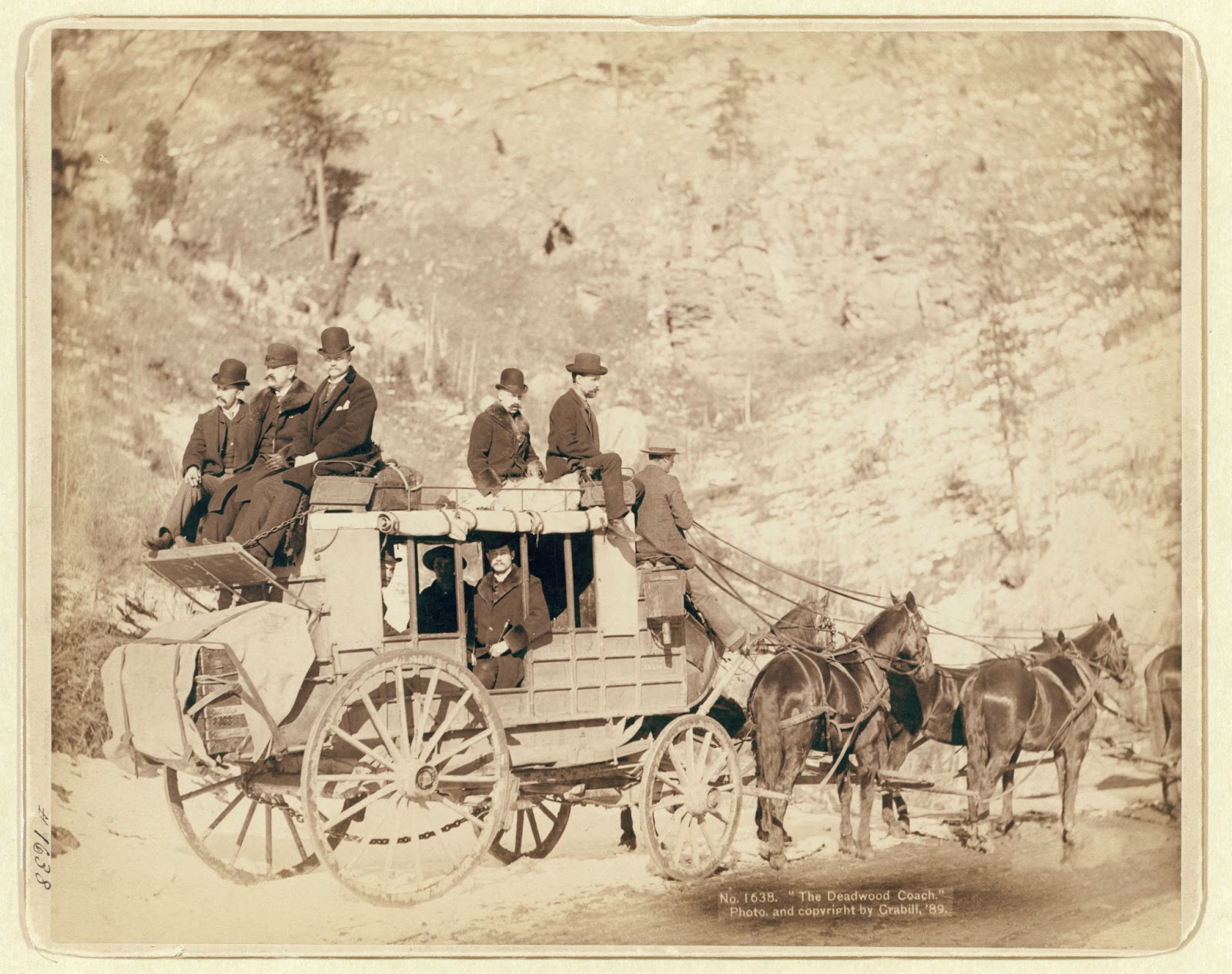
The Deadwood Coach. Photo taken in 1889 by John C. Grabill. 

Stagecoach travel was a dangerous business in the American West. Roads were rocky, rutted, and sometimes impassible. Bandits, a constant threat, viewed stagecoach passengers like cats watching birds in a cage. 

It was also an uncomfortable form of travel. On long trips, passengers generally slept sitting up, or not at all, as it was considered bad etiquette to rest ones head on another passenger. Rest stations, or swing stations, were used to change out horses and rarely offered food. 

Nevertheless, the stagecoach was a popular form of travel in the American West, particularly during a time when the only other option was a wagon or the back of a horse! 

Stagecoach Design: The Concord Stagecoach

The Concord Stagecoach was used most often by stagecoach companies. It was built like a basket on leather straps that swung from side to side. Concords had seats in front, in back, and in the middle, seating nine when full and leaving little leg room with seating for up to 12 passengers on top. 


The creators of the Concord were J. S. Abbot and Lewis Downing, meticulous craftsmen who personally inspected every coach that left the factory. The Abbot Downing Company had a huge factory in Concord, New Hampshire on six acres. They offered designs for forty coaches and wagons. The company was supervised by one of the Abbot or Downing family members from 1827 to 1899.


Concord Stagecoach. Photo taken in 1869.

According to The Story of the Great American West, Concord coaches came in various heavily varnished, bright colors and various sizes, as well. They were 8 1/2 feet long (now imagine the space inside of the coach), weighed 2500 pounds, which could be deadly if they tipped over on a road, and cost around $1300 depending on the amount of detail.

The Jehu, or Stagecoach Driver

Jehu is a Biblical name given to stagecoach drivers. Jehu was a king of Israel in the ninth century who, according to II Kings, ordered the death of Jezebel according to Elijah's prophecy. On the Old West Stagecoach, the jehu was the man, he was in charge. He was the one who shouted, "All aboard! Away!" as the passengers scrambled to find their seats and they did scramble, because it was often vitally important for the jehu to keep his schedule and he was not willing to wait for slackers fumbling around inside the coach. Stagecoach's were not just for passengers. They often carried important legal documents, large bank deposits, or company payrolls.

The Jehu held three pairs of reins in his left hand, which kept his right hand free to hold the whip. According to The Story of the Great American West, The jehu also spoke to the horses, not just shouting commands, but also encouragement, and sometimes soothing words when the stagecoach was in a precarious situation, such as traveling a mountain road.

The jehu's hold on the reins was careful, sensitive, like a pianist touching the keys of a piano because he knew the horses responded to the slightest movement of those reins and depended on him for guidance at every moment. The jehu often wore thin gloves so he could more carefully guide the reins. Unfortunately, this sometimes led to frostbite--it was not an easy job!

Stagecoach Companies: Ben Holladay and the Overland Express

According to David Niven's The Expressmen, one of the most famous stagecoach owners and operators was Ben Holladay. Holladay's personal stagecoach had the appearance of a royal carriage with its gold scrollwork and prancing, dapple-gray horses, but Holladay could afford the extravagance. He owned the Overland Mail Express Company, which he bought from the Pony Express in 1862. He had a contract with the United States Post Office that paid $365,000 a year. 


The Overland transported humans, packages and mail over a 3000 mile area. Its stagecoach drivers wore velvet-trimmed uniforms and Irish wool overcoats, and Holladay paid them well. Holladay employed more than 15,000 people in the Overland Company with 110 Concord Stagecoaches. Holladay sold his stagecoach company to Wells Fargo in 1866 to invest in the railroads.

The Dangers of Stagecoach Travel

According to Wells Fargo History, during the gold rush years in the Rocky Mountains the Wells Fargo line had such a difficult time protecting its passengers and cargo that it created a standard form letter for reporting robberies. Wells Fargo nailed safes to the floorboards of the coaches, hired armed guards to protect shipments and taught silver shippers how to melt their precious metals into bars too large to be carried by men on the run, and still their stagecoaches were robbed. 


Wells Fargo finally created its own detective agency, but the salaries of these officers were so high they matched the amount previously lost in robberies. Nevertheless, the company felt some satisfaction in knowing justice was served when famous robbers such as John Sontag and Black Bart were apprehended or killed.

The End of the Reign of the Stagecoach

Ben Holladay made a wise financial decision when he sold the Overland Mail Express Company as railroads soon became the primary method of transporting both humans and cargo, but trains were still confined to their tracks. It was the introduction of the automobile that finally brought an end to the use of stagecoaches in the early 1900s.

Sources:

  • Nevin, David. The Old West: The Expressmen. Time Life Books, 1974. 
  • "Overland via Stagecoach." Wells Fargo History. Retrieved February 10, 2009. 
  • "The Concord Coach." Abbot-Downing Concord Coach. Retrieved February 10, 2009. 
  • The Story of the American West. Reader's Digest Association, Inc. Canada, 1977.


Monday, May 20, 2013

Levi Strauss and the Jeans that Won the West


Levi Strauss was a German-Jewish immigrant from Bavaria who arrived in New York in search of the American Dream--and he found it! On Monday May 20th, 1874, Levi Strauss  & Company first offered blue jeans with copper rivets at $13.50 a dozen, and the rest of the story, as they say, is history. 

On May 20th, 1874, Levi Strauss introduced blue jeans with copper rivets bringing great joy to miners and workers across America who spent far too many years using rope to tie up their threadbare working pants!

Levi Strauss & Co. 506 jeans. Image by M62.


When Americans think of blue jeans, they think of Levis. Levi Strauss & Company has provided durable, attractive clothing for America’s cowboys, factory workers, and rebellious teens since the mid-1800s, and the story of Levi Strauss, the man, is as remarkable as the enduring success of the jeans that wear his name.


How the Strauss Family Came to America

On February 26, 1829, Löeb "Levi" Strauss was born in Buttenheim, in the Franconian region of Bavaria, Germany, to Hirsch and Rebecca (Haass) Strauss, who already had three sons and three daughters. Löeb was nicknamed “Levi” by his family. Levi Strauss’s father died in 1845.

Levi Strauss portrait.

Prior to their father’s death, Strauss’s brothers left their homeland for the United States and started a dry goods business in New York City. In 1847, Strauss, his mother, and three sisters traveled to America to join his brothers. In 1853, Strauss earned his American citizenship. That same year, he also decided to follow the gold hunters headed for California, but Strauss was not seeking gold. His plan was to start a subsidiary of his brothers’ dry goods store, importing clothing, umbrellas, and other items to sell to small stores that were opening throughout California near mining towns.

Following the Crowds to California

Levi Strauss was a successful businessman in California and he decided to share his success with his family. He sent for his sister, Fanny, and hired his brother-in-law, David Stern, into the company. The business thrived, and by the time Strauss was in his mid-thirties, he was a popular business man in San Francisco.

Coal miners, Ouray County, Colorado, 1890

And yet, as he made the rounds in his wagon with his dry goods, he noticed one thing that most miners had in common, one thing they were missing: durable pants. The pants worn by miners and factory workers were made of cotton, and often falling apart.

Jacob Davis Joins Levi Strauss

One day, Strauss received a letter from a customer, Jacob W. Davis, an immigrant from Latvia who arrived in the United States in 1868. Davis was a tailor in Reno, Nevada who had a design for a good pair of pants. He was purchasing fabric from Strauss to make tents and wagon covers. He started using copper rivets to reinforce horse harnesses. Then he came up with the idea of using these same copper rivets to hold pants together in areas under the most stress, and to use tent fabric to make the pants.

Levi's now come in many shapes and sizes for every member of the family.
 Photo by Darla Sue Dollman.

Davis, however, lacked the necessary money to purchase a patent for his product. Levi Strauss met with Davis and the men agreed to become partners, creating the first official pair of Levi work pants in 1873. Within a matter of a few years, Levi Strauss & Company was making history with their durable pants for miners, factory workers and cowboys. These early pants, however, were died brown, and not the popular blue worn around the world today, and they were not widely distributed until the 1890s.

Disaster Strikes Levi Strauss & Company

In 1906, an earthquake struck San Francisco, California and the original factory on Battery Street and all historical records of the company were destroyed in the horrific fire storm that followed.
San Francisco, following the earthquake of 1906.

Following in the tradition of their benevolent uncle, Strauss’s nephews rebuilt the company as quickly as possible and during the process they continued to pay their employee’s salaries and to assist other business owners in their efforts to rebuild. Levi Strauss & Company is one of the most successful businesses in America to this day.

Beloved Citizen and Benefactor

Levi Strauss was a compassionate and generous man and regular contributor to the Pacific Hebrew Orphan Asylum and Home, the Eureka Benevolent Society, and the Hebrew Board of Relief. He also funded scholarships for poor students at the University of California. He never married.

Levi Strauss Museum in Buttenheim, Germany.

Levi Strauss died on September 26, 1902. He left the bulk of his fortune, nearly six million dollars, to his extended family, his favorite charities, and to the Roman Catholic Protestant Orphan Asylums. He left his factory and Levi Strauss & Company to his nephews, the children of Fanny and David Stern.

Levi Strauss is buried in Colma, California. In his obituary, the L.A. Times referred to Levi Strauss as “one of the last of the oldtime merchants of San Francisco and one of the best-known men from the most southerly limit of California to Puget Sound.”

There is now a Levi Strauss Museum in Buttenheim, Germany.

Sources:
  • Downey, Lynn. "Levi Strauss & Company.” Levi Strauss & Co. Official Website. Retrieved January 10, 2010.
  • Freeedman, Russell. Cowboys of the Wild West. Scholastic Inc.. Boston: 1985. 
  • “Levi Strauss Dead at San Francisco.” Published L.A. Times, September 28, 1902. Retrieved January 12, 2010. 
  • Levi Strauss California Museum. Retrieved April 20, 2013. 
  • “Our Past is a Glimpse into the Future.” Heritage. Levi Strauss & Company. Retrieved January 12, 2010. 

Friday, May 10, 2013

Wallace Stegner, 'Living Dry'

Cholla at Sunset. Photo by Darla Sue Dollman

“If there is such a thing as being conditioned by climate and geography, and I think there is, it is the West that has conditioned me. It has the forms and lights and colors that I respond to in nature and in art. If there is a western speech, I speak it; if there is a western character or personality, I am some variant of it; if there is a western culture in the small-“c”, anthropological sense, I have not escaped it. It has to have shaped me. I may even have contributed to it in minor ways, for culture is a pyramid to which each of us brings a stone.”--Wallace Stegner, 'Living Dry,' 1987

Thursday, May 2, 2013

Question about "Message Trees"


I have a question from a reader and I thought of posting the question on the article where it was attached, but it's a bit down on the list, so I think I'll open this topic up to everyone in case someone else has better information sources to help out. If you have an answer, you can comment on this post and I will notify her via email, or she'll see it on the blog. Either way, please help if you can! I think it would be great information to share with everyone! The question is below:

"I'm doing an article about the Message Trees. There is a trail between Colorado and New Mexico, where the cattlemen drove their cattle. They left messages in the trees along the way. The dates go back to early 1900. Do you know anything about this?" --Betty J. Slade

Tuesday, April 30, 2013

Ring-Tailed Cats, or Miner's Cats: Pest Control for Miners and Pioneers


Ring-tailed Cat, or Bassariscus astutus.

If you've ever wondered if pioneers, miners and settlers had pets the answer is yes. They had dogs, and perhaps even house cats, but in the Southwest, they had a special kind of pet, a pet that resembles a combination of cat and raccoon, and I've had the privilege of sharing my backyard and roof with one of these wonderful creatures, so I will begin with my story.

Cunning Bassarisc. Bassariscus astutus. Frank E. Beddard - The Cambridge Natural History, Volume X—Mammalia. Wikimedia Commons/Public Domain. 

My husband and I were living in Texas a little over a year when we first realized we had a rather unique friend visiting our house at night. We lived in a round house with mostly glass walls for windows and glass doors--I often felt like a goldfish and the wildlife watched me as I moved through my home. I loved to climb onto the roof and photograph the sunset, but I always felt as if I was watched. 

Our son told us he often heard noises in the garage at dusk and swore he saw what looked like a raccoon tail hanging down in front of the small garage window. Our house was on a mountainside and the garage backed to a slope, so it seemed logical that a raccoon might be climbing onto our roof, but why? They had free access to the squirrel and bird food on our bedroom patio, so they would not be seeking food. The raccoon theory didn't seem to fit. Still, it was a clue--a feeling of being watched and a raccoon tail.
Ring-Tailed Cat sprawling on a rock in Arizona. This is how the Ring-Tailed Cat 
looked at us from the tree branch in our backyard. Photo by RobertBody.

The clues all came together one night around sunset when my husband realized he left the water hose running in the back yard. Suddenly I heard him calling my name. I ran to the garage and out into the yard and found him standing by the fence beneath a tree. Directly above his head was one of the strangest creatures I've ever seen--a Ring-Tailed Cat. 

Ring-Tailed Cats are curious little creatures. Their heads resemble chihuahuas with pointy ears and large eyes. They have the body of a limber, athletic house cat and a long, striped tail like a raccoon. This little creature was sprawled out on a tree branch watching my husband as if he lived in the house and my husband was a visitor. It was a fascinating moment. He seemed perfectly comfortable with us and I suddenly realized why I often felt I was watched while on the roof in the evenings--because I was being watched!

A few nights later we were watching television in bed when we heard noises on the bedroom patio. This was not an isolated event. We were often visited by families of raccoons and an o'possum. On this night, though, it was the return of the ring-tailed cat. He raided the sunflower seeds in the squirrel dish then walked over to the door and stared inside at us for awhile before moving on. 
The seven-foot Eastern Diamondback Rattlesnake that often visited our backyard, only at sunset, though, which gave us time to secure all of our pets and people inside the house. 
Photo by Darla Sue Dollman.

In the five years we lived in the house the Ring-Tailed Cat often came by for a visit. Sadly, I never managed to photograph him. Nevertheless, we thought of him as a family friend, like the female toad, Mrs. Toady, who slept in my garden shoe during the hot summer afternoons, and the seven foot rattlesnake who slithered through our backyard at night to drink water from our pond. 

Ring-Tailed Cats as Beneficial Pets

Of course, I studied the little creature so I could write articles about him on my animal blog, Blessed Little Creatures, and that's when I learned that although the Ring-Tailed Cat is often described as a solitary, nocturnal, and rather timid creature, it also has a reputation as a beneficial pet. In fact, Ring-Tailed Cats played an important role in the taming of the American West by helping to eliminate disease-spreading rodents like rats and mice. 

They were favorites of miners and pioneers who cut holes in boxes and placed the boxes near the stove in the cabin or home to keep the animal warm during the day. At night, the ring-tailed cats would sneak out of their boxes to feed on the mice and rats that dared to enter the homes. This is how the ring-tailed cat earned its second name as the "Miner's Cat."


A Southwestern Native

The Ring-Tailed Cat is most often seen in the Southwest, in states such as Texas, New Mexico, and north and central Mexico. They are also seen in California, Colorado, Oklahoma, Oregon, Arizona, Nevada and Utah. Their location is understandable considering they prefer to make their homes in rocky, desert places, but they can also be found in the hollows of dead trees or in abandoned buildings.
Ring-tailed Cat at Phantom Ranch, Grand Canyon National Park, Arizona. 
Photographed by Pixelfugue.


To protect themselves from predators, they frequently move their dens, rarely spending more than one night in the same place. They are amazingly agile and flexible, and can rotate 180 degrees. They have also been seen performing cartwheels and using their agile bodies to ricochet between walls!

A Rather Unique-Looking Cat!

The ring-tailed cat (Bassariscus astutus) can be tan or dark brown with a lighter underbelly. It has pointed ears and large, purple eyes surrounded by tufts of light-colored fur. It is smaller than a house cat, generally measuring about 16 inches long with a weight of 3 to 4 pounds. 

Ring-Tailed Cat in Arizona. This photo may help you understand why I think they look like my chihuahua! Photo by RobertBody.

One of its most distinctive features is its long tail. The ring-tailed cat has a tail that is about 14 inches long, fuzzy, and lined with dark rings similar to that of a raccoon. As it is most active in the evening hours, it is easily mistaken for a raccoon in the dark.


Eating and Breeding Habits

Ring-Tailed Cats eat fruit, insects, rodents, and small birds. Their preference for small rodents makes them a beneficial creature. They mate in spring with a gestation period of 45-50 days, calling to their mates with a loud bark. The male hunts food for the pregnant and nursing female, who generally produces between two and four cubs. Baby ring-tailed cats are hunting on their own by four months and breeding at ten months.
It's not likely that my pet dog, Chewy the Chewchewcabra, would have threatened 
the Ring-Tailed Cat, but you can see why I compared their appearance to a chihuahua! 

Ring-Tailed Cats live to around seven years in the wild, but they often fall victim to raccoons, coyotes, owls, foxes, bobcats, mountain lions, and even pet dogs. Surprisingly, one of the ring-tailed cat's greatest threats is humans. Farmers often kill the creatures to protect fruit crops. In spite of the large number of predators, they are not considered an endangered species.

Pioneer Pest Control

In the American Southwest, where people rarely had fruit crops to protect, Ring-Tailed Cats were often seen in mining towns and pioneer settlements because the little creatures did not feel threatened. Their presence was accepted in much the same way towns once accepted the presence of dogs and cats wandering through town, and welcomed because they controlled the population of rats and mice.

So the next time you read about the American Old West, the townspeople and the miners and how they kept their homes free of pests, remember the Ring-Tailed Cat--pest control for the pioneers! 

Sources:
  • Goldberg, Jeffrey. "Bassariscus astutus: Ringtail." Animal Diversity Web. Retrieved April 30, 2013. 
  • Poglayen-Neuwall, Ivo and Toweill, Dale E. "Bassariscus astutus." Mammalian Species. The American Society of Mammologists. No. 327, pp. 1-8. Retrieved April 7, 2011.
  • Williams, David B. "Ringtail Cat." DesertUSA. Retrieved April 7, 2012.

Christmas dinner for a family, from a series of photos documenting Gen. John J. Pershing's 1916 Punitive Expedition into Mexico. ...